
Trump’s Gaza Gambit: Imperfect, But an Opportunity Israel Can’t Ignore
After almost two horrible years of war, President Donald Trump’s 21-point plan for Gaza has put forth a bold - yet far from perfect - proposal to end the war. That does not mean Israel should say no.

"Bringing the hostages home alone would relieve an entire nation, resurrecting the Israeli ethos of being a safe haven for Jews - an ethos broken on, and since, October 7."
What’s In It
Announced yesterday in a press conference with Prime Minister Netanyahu, following a meeting at the UN General Assembly with leaders from Saudi Arabia, Qatar, Egypt, and Jordan, the plan calls for an immediate and complete ceasefire and the release of all remaining hostages within 72 hours of adoption.
Hamas would be disarmed and removed from power. Governance in Gaza would be transferred to a professional technocratic governing board under former UK Prime Minister Tony Blair, with deep involvement from a reformed Palestinian Authority. Public safety and Israel’s security would be ensured by an international Arab-and-Muslim stabilization force, and reconstruction would begin with Arab and international funding.
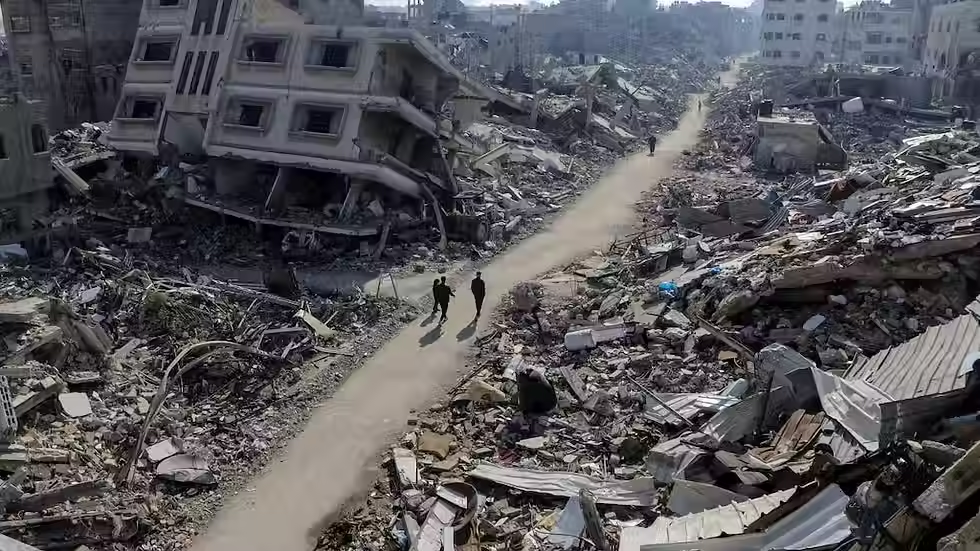
For Israel, the most important gain is obvious: bringing the hostages home. That step alone would relieve an entire nation, resurrecting the Israeli ethos of being a safe haven for Jews - an ethos broken on, and since, October 7. On the Palestinian side, ending the war and flooding Gaza with long-overdue aid would stop the humanitarian crisis and save countless lives.
In the long term, introducing a governing alternative led by Palestinians, Arabs, and Muslims committed to stability is a good step for the Palestinians and the region, as it will allow physical reconstruction to turn Gaza from a permanent source of instability into a source of prosperity.
"Hamas enjoy at least some support from the population. A feasible long-term plan for the region must ensure that the institutions spreading Hamas’s ideology - including mosques, schools, and the welfare system - are replaced with institutions that promote coexistence."
Where Is the Catch
There is no such thing as “a perfect deal,” and even though this plan leans toward Israel’s interests - making it harder for Hamas to accept - Israel is still forced to make significant concessions.
A major flaw has to do with Hamas remaining a force on the ground - not with fully functioning government or military capabilities, but still operational. Past experiences have shown that third-party forces are not eager to conduct counter-terrorism missions (UNIFIL in Lebanon, where Hezbollah grew into a full-scale military under its nose, is a notable example). The fact that President Trump guaranteed Israel freedom of operation in case of such a failure is positive, but it still falls short of fully addressing Israelis’ legitimate concern that a surviving Hamas will remain committed to harming us.
Another flaw, more dangerous in the long run, concerns Gaza’s social reconstruction. Last year, LIBRAEL presented a four-pillar strategy for the day after in Gaza called "The Meatball Sub". While three of those pillars - counterinsurgency efforts, a governing alternative, and physical reconstruction - are met in President Trump’s plan, the social reconstruction element is missing.
While it is not true that all Gazans support Hamas, we must acknowledge that Hamas are not outsiders to Gaza; they enjoy at least some support from the population. A feasible long-term plan for the region must ensure that the institutions spreading Hamas’s ideology - including mosques, schools, and the welfare system - are replaced with institutions that promote coexistence. So far, we have not seen anything in this plan that commits to such a move, e.g., dramatically reforming UNRWA.

Yet - We Must Say Yes
Here is the uncomfortable truth: Israel cannot afford to reject this plan, especially once the United States has planned and promoted it. We’ve reached the point - months ago, in fact - where the war, which has cost us dearly in lives, resources, and international standing, is failing to deliver its legitimate objectives.
We cannot dismantle Hamas more than we already have. We clearly cannot rescue the hostages through military operations. International patience for the war is long gone, and more and more political, economic, cultural, and eventually security pressure is being placed on us. Responding with defiance will lead Israel to be more isolated and hence less secure - not more.
Israel’s objectives in implementing this plan must be clear: robust verification of disarmament, deep Israeli involvement in international stabilization efforts, clear U.S. guarantees for Israel’s right to self-defense, and an international commitment to social reconstruction.
At the same time, it is on us to reject the hardliners who see any compromise as weakness and who believe, despite evidence, that mere military power can protect us. It is on us to enter negotiations in good faith (without compromising on our interests) and leverage this moment to expand peace: with Riyadh, with Islamabad, with Jakarta, and beyond.
This is not weakness; it is strategic clarity. This is not conceding to pressure; it is leveraging hard-earned military gains to improve our standing. It will save countless lives - Israeli hostages, Israeli soldiers, and Palestinian civilians - and allow both peoples to start healing.
Just as Israel once took risks for peace with Egypt and Jordan, including making severe concessions - risks that paid off with decades of quiet borders - we must again weigh diplomacy. Not with fantasies about peace in our lifetime, but with a clear-eyed, feet-on-the-ground vision that will protect Israel as the democratic, secure, and prosperous nation-state of the Jewish people, while providing the Palestinians with a path to live in freedom and security.
The plan is flawed. It is risky. It may fail, as we all wait for Hamas to respond. But there is a reason a huge majority of Israelis, including many who vote for the coalition, support the deal. Israel must not let our fears - cemented in the atrocities of October 7 - hold us back from pursuing a better future for both peoples. Bold diplomacy, not endless war, is what will secure Israel’s future.
---


Comments